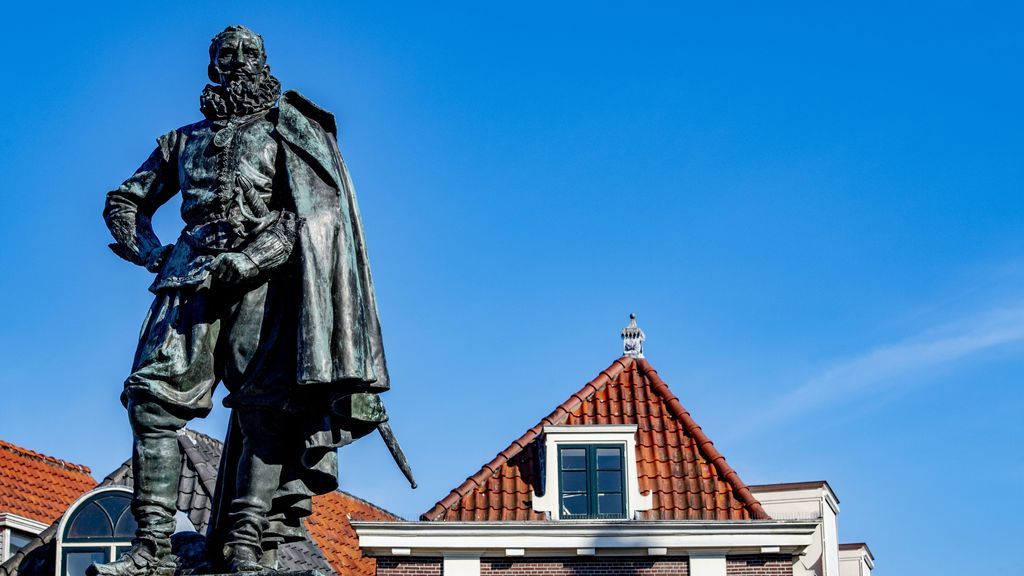
The nation-state is increasingly under fire. So are those who argue for its revaluation. It is taboo to be proud of the heroic deeds of our ancestors, to sing a paean to the past, let alone cherish the thought that our collective past involved something as terrible as a Golden Age. Against that backdrop, two recently published books are - except for a few details -- a breath of fresh air.
Not that they unabashedly sing the praises of our Golden Age. Instead, the book edited by Amsterdam professor of international law, Louis Sicking, published by Prometheus, argues that our talk of the Golden Age is too much focused on Holland. When we zoom out, it turns out that the Netherlands experienced many golden ages. Indeed - the title of the volume makes this immediately clear: every Dutch province had its own Golden Age.
National awareness
Now the sceptic might remark that this again relativises the image of 'our' national Golden Age. But that would be a little too sour. I learned from my Leiden professor of Fatherland History, Simon Groenveld, that national awareness is usually layered. For instance, it was an anachronism to speak of a nation-state as early as the 16th century, because it did not take shape until the 19th century.
As today, many people's national feeling often did not extend beyond the borders of their own village or town, if possible the region, in one case the province, but hardly 'the Netherlands' as a whole. Nor did one rule out the other. Dordrecht and Amsterdam were in part competitors in terms of trade, but in the fight against Spain they were on the same side. Not because they felt like Dutchmen at the time, but because as cities they had shared interests in that struggle. You could count on most residents of both cities at the time to celebrate the victories of the State armies led by William of Orange and, later, Maurice and Frederick Henry.
Thus, a Golden Age of one's own province does not have to detract from a national Golden Age, but can actually help gain a view on the multicoloured nature of our national history and the distinct identity of each of the regions within our nation state. Indeed, rightly putting one's finger on it can even enrich the collective national awareness. At least, that is what reading the book triggered in me.
Not all that glitters is gold
Not that the Golden Age of every province is equally important. That the Frisians can look back on an illustrious past in the early Middle Ages is beyond dispute. At the time, their empire stretched from North Holland through present-day Friesland, Groningen, Drenthe and parts of Overijssel far into Germany. And their monarchs have always had a place in our national history books.
But that the Zeeland island of Walcheren must once have been rich, because otherwise the Vikings would have ignored it in their conquests, is a bit thin for the claim to a Golden Age of its own. Rather, I am inclined to think of the role of the Zeelanders during the Eighty Years' War. While Dutch cities often wavered, time and again they formed the backbone of the Revolt.
Drenthe, too, never had a real Golden Age. Especially if we consider that the many social initiatives developed there in the peat colonies have had very little impact on the prosperity of the average inhabitant of Drenthe.
Undeniably, many villages around the Zuiderzee played a heroic role in the battle against the elements, and for a long time were also able to accumulate wealth through fishing. But to attribute a Golden Age to Flevoland on that basis is a bit of a stretch. The formation of this province by reclaiming large parts of the Zuiderzee was too radical a break with the past for that.
The chapter on Groningen is particularly poignant. There it talks about the Golden Age of natural gas extraction. In the light of current history, that is surely more of a black page in the history of this province. Surely there is a strong feeling that the rest of the Netherlands became rich on the backs of the Groningers. Perhaps one day, when all the suffering is over, they will look back with pride on their contribution to the welfare state that the Netherlands once was. But it seems a little too early for that now.
Medieval heyday
Against less convincing chapters, there are fine stories about Utrecht, Overijssel, Gelderland, Limburg and Brabant. In the middle of the Middle Ages, Utrecht was the ecclesiastical and, hence, cultural centre of what we now call the Netherlands. In terms of architecture, the city had no equal for miles around. In addition, as a bishop's seat, it formed a cultural aura that would continue to exert its influence well beyond the Middle Ages. Life stories of bishops naturally served to emphasise their exceptional position as head of the church.
At the same time, they also emphatically appealed to the ordinary faithful. And even then names were clear that there was a difference between saints' lives and reality. The founding father of the diocese of Utrecht, the ninth-century bishop Frederick, was known to have had a child as a cleric with a woman of the world. But, like everyone else, he deserved a second chance and rehabilitated himself as a heroic church leader who did not hesitate to criticise secular leaders when they went after his flock. In any case, it becomes clear that the holy fire in our regions did not start glowing only in the period of Renaissance and Reformation.
The chapter on Gelderland tells a similar story. If in the early Middle Ages it was still about heroic clerics, in the late Middle Ages, led by men like Geert Groote and Thomas van Kempen, we clearly see an appeal for inner renewal from ordinary believers. There, faith permeates all daily actions, from prayer and Bible study to diligent work and generous care for the needy neighbour.
This movement we know as that of the Modern Devotion eventually produced great humanists like Desiderius Erasmus and the later Pope Adrian IV. Both scholars had been apprenticed to Groote. What characterised them was that they did not shut themselves up in their own academic bubble but emphatically tried to connect with the everyday social life and questions of ordinary men and women of those days.
Material prosperity
But if we think it was this movement - or that of later Protestants like Martin Luther -- which first sought to translate classical works into the vernacular, we are wrong. It was happening centuries before that in Limburg. That translation work contributed more than anything else to the formation of the final Dutch language. It is in Limburg that we also come across the first Dutch-language literary works.
And anyone who thinks that Holland was the cradle of exceptional material prosperity in the Low Countries forgets the wealth of the old Hanseatic towns in Overijssel and, of course, the fabulous wealth acquired by Antwerp during the heyday of the Brabant-Burgundian Netherlands. This book rightly pays extensive attention to that.
But with all that, of course, nothing has been said to the detriment of Holland's Golden Age. That is still undisputedly the heyday of at least the northern Netherlands. The architecture of a city like Amsterdam provides ample evidence of that. The art of Rembrandt, Jordaens and Lievens is still considered one of the high points of artistic creativity in world history. After the fall of Antwerp, Amsterdam became the centre of world trade. From there, Dutchmen sailed all the world's seas. And the combination of wealth and military ingenuity transformed the Netherlands, under Holland's inspired leadership, into a world power.
On the backs of slaves?
Of course, in that period, this was not done without the use of slaves, but on a scale that was small compared to that of many other countries. The contribution of slavery to the economy averaged no more than five per cent throughout the Golden Age. In this book, this aspect of history casts a relatively heavy shadow over Holland's economic and cultural achievements. In my view, this is disproportionate - especially considering that Prometheus has also published several books by another teacher of mine, the internationally lauded expert on economic expansion in this period of history, Piet Emmer. Without waving away the downsides, his overall picture looks considerably less morbid than many today would like to believe to be true.
The Batavian revolt
The tendency to focus on the dark sides of the Golden Age is also present in the book The Art of Power, beautifully edited by Amsterdam art historian, Elmer Kolfin, and published by Waanders.
Central to it is not so much the vision of the painters (Jordaens, Lievens and Rembrandt), but that of the patrons: the Amsterdam mayors (Cornelis and Andries de Graeff). It was they who commissioned the so-called Batavian cycle in the Royal Palace on Dam Square.
The cycle comprises a total of six imposing paintings that refer to the revolt of the Batavians led by Claudius Civilis and Brinno in the years 69 to 70 of our era against Roman rule in parts of Europe that would form the Netherlands almost 16 centuries later. The parallel was clear: just as the Batavians had once defeated the Romans, the Dutch had now defeated Spain.
Amsterdam's pride was reflected in the palace commissioned by the ruling regents - at the time intended to serve as a town hall. Constructed entirely in classical style, it was inspired by the images known from the palace of Old Testament Solomon, the greatest king Israel ever knew.
A fortune was involved in furnishing the city hall. Even if the artistic quality of the cycle could be questioned, for the purpose for which it was made it suffices perfectly: to emphasise the grandeur of the Revolt against the Spanish empire. The parallel with the Batavians was also that their leader, like that of the Revolt, owed his pre-eminence to the support representatives of the common people.
Slavery or inclusivity?
According to Kolfin, this was also the view of the Amsterdam regents when they awarded the commission. And to my mind, that conclusion is entirely convincing, since in the painting in question, within the cycle, it is not just slaves who lift up the Batavian leader Brinno onto a shield, making him their leader, but a select company of citizens. Regents were considered the representatives of the bourgeoisie.
All the more curious is the somewhat dutiful comment the author makes about the black figure hoisting the leader of the Batavian rebellion on the shield.
He emphasises that no blacks could be involved in the revolt, simply because they were not to be found in these parts at the time. But if we believe that there is a parallel with Brinno and the Orange city officials, the subordinate position of the black figure now reminds us of how we would have used and exploited blacks for honour, glory and gain. The black figure, in short, reminds us of the black page of our Golden Age history.
But can that conclusion be drawn on the basis of the painting? Does it not rather speak to the guilt of the contemporary Dutchman, who is told that we treated the indigenous inhabitants of our overseas territories so badly? Is every black man we encounter in a Golden Age painting a slave?
Instead, in the painting in question, the black figure has a place of honour. Indeed, if we assume that in the mindset of the regents, the Oranges owed their position to the States as representatives of the bourgeoisie, then a place among the bearers of the shield on which the stadholder stands is rather a sign of recognition of the essential role played by the inhabitants of the overseas territories in the success of the rebellion. Long before we frenetically sought out the role Moroccans might have played in the war against Nazi Germany, the painting already depicts a form of inclusiveness that was centuries ahead of its time.
Our national pride
On the positive side, The Art of Power can be read as a contribution to the debate on the role of art in society then and now. In doing so, it is inevitable that our view will be coloured by our own preoccupations. But it is also the task of the scholar to detach himself from this and let the painting speak for what it is - a political propaganda tool, in which the success of the Revolt against Spanish rule is highlighted and in which, on the orders of the then rulers, people whom we would too easily forget were assigned an essential role.
Every reason, therefore, to be and remain proud of our Golden Age. The Revolt and the trade empire which was established shortly afterwards, and which brought us so much prosperity and civilisation, would not have been possible without the indomitable spirit of freedom and entrepreneurship that characterised the inhabitants of these parts at the time. That this mentality did not fall from the sky, but has its roots in a more distant past, including outside Holland, does not detract from this - on the contrary: it can also serve as a source of inspiration for the present.
Both books - both Every Province Its own Golden Age and The Art of Power - tell that story each in its own way. For that reason, and despite some critical comments: highly recommended reading.
Sources:
Elmer Kolfin, De kunst van de macht. Jordaens, Lievens en Rembrandt in het Paleis op de Dam. Uitgave van Waanders te Zwolle, 2023; 176 pag.; € 39,95.
Louis Sicking (red.), Elke provincie een eigen Gouden Eeuw. De bloeiperiodes van Nederland, 7de – 21ste eeuw. Uitgave van Prometheus te Amsterdam, 2024; 278 pag.; € 25.